How Much Does It Cost to Build a 1,500 Sq.ft Home?
A worked 2026 example for a 1,500 sq.ft independent home: structure, finishing and turnkey totals, the items outside the rate, and where the budget usually stretches.
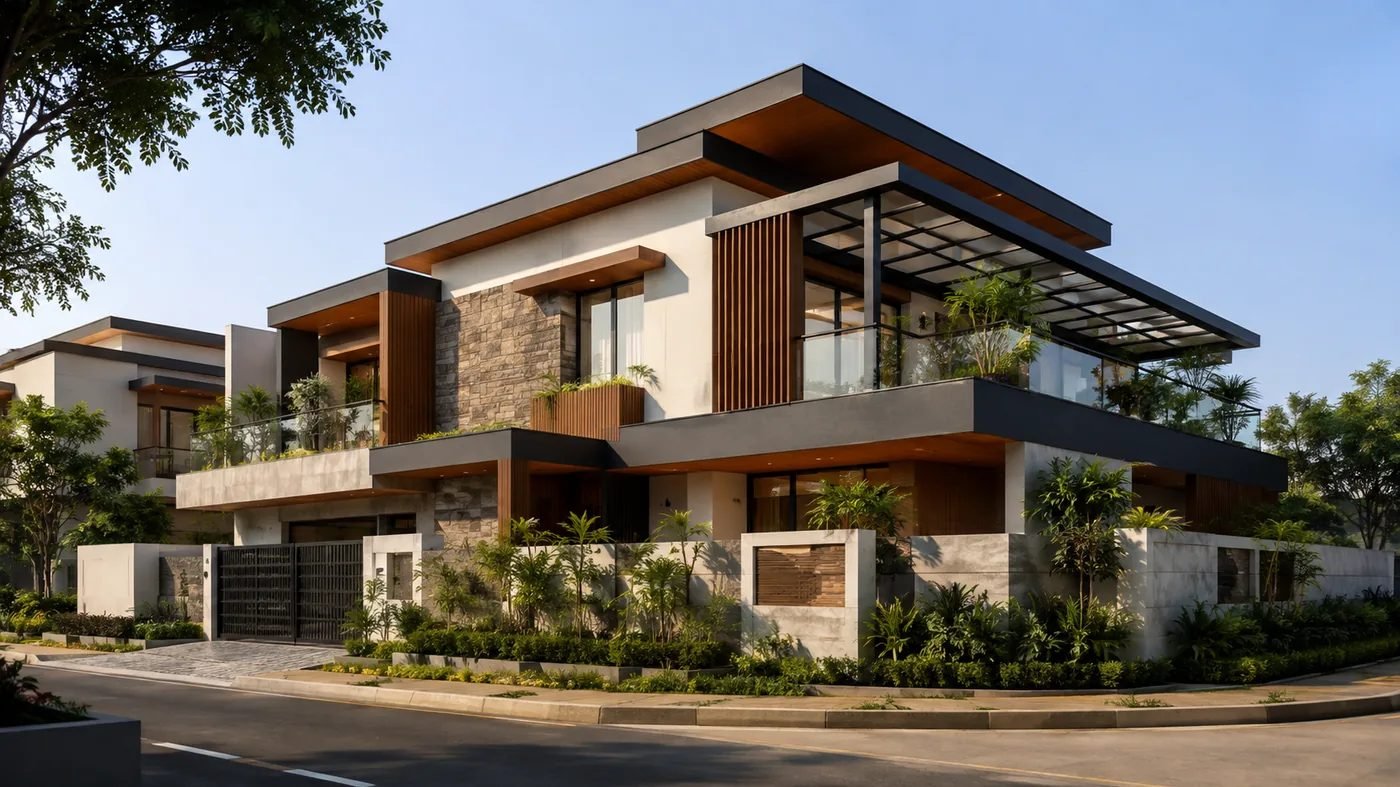
1,500 sq.ft is a common size for a two-bedroom ground-plus-one home or a generous single-floor plan. Because the area is modest, fixed costs — foundation, staircase, water tank, one kitchen, two or three bathrooms — weigh more per square foot than they would on a 3,000 sq.ft home. The worked example below uses 2026 Pune rates; scale it to your city using the ratios rather than the absolute numbers.
Worked example: 1,500 sq.ft G+1
| Scope | Rate (₹ / sq.ft) | Amount (₹) |
|---|---|---|
| Structure — Preferred spec (M25, Fe500D) | 1,350 | 20.25 lakh |
| Finishing — Preferred spec | 1,050 | 15.75 lakh |
| Turnkey subtotal | 2,400 | 36.0 lakh |
| Design and structural consultancy (est.) | — | 1.2 lakh |
| Compound wall, gate, borewell, connections (est.) | — | 3.0 – 4.5 lakh |
| Indicative total excluding plot, approvals and interiors | 40 – 42 lakh |
At the Essential specification the turnkey subtotal drops to about ₹28.5 lakh; at Premium it rises to roughly ₹44 lakh. The spread comes almost entirely from finishing allowances and material grades, which is why two homes of identical size can differ by ₹15 lakh without either builder being "expensive".
Why small homes cost more per square foot
- A staircase, overhead tank, plinth beam and footing set are needed whether the home is 1,500 or 2,500 sq.ft.
- Bathrooms and kitchens are the most expensive rooms per square foot, and a 1,500 sq.ft home still needs two or three of them.
- Formwork and scaffolding mobilisation is largely fixed per floor.
Where the budget usually stretches
In our experience the additions that move a 1,500 sq.ft budget are rarely structural. They are the extra bathroom decided mid-way, the shift from vitrified to large-format tiles, upgraded windows, and a false ceiling in every room. Each is legitimate — but decide them before the quotation, not after the plaster. We cover the pattern in Where Home Construction Budgets Usually Overrun.
- Confirm the area basis (built-up) used in the quote
- Confirm concrete grade, steel grade and block type
- Confirm finishing allowances per item
- Add a 5–8% contingency for site conditions
- Keep interiors as a separate, later budget line
Prices are indicative and vary with location, design, specifications, market conditions and project scope. They are not a quotation.